Introduction
I once walked into a small café on a rainy Tuesday and noticed the under-counter lighting looked patchy—uneven bands of brightness that made the pastries look tired. In that very shop the owner had installed LED strip LED lights across three counters, spending over $400 on tapes that promised “smooth light” but delivered hotspots instead. The data is blunt: a recent shipment I audited in March 2022 showed a 27% return rate on consumer-profile flexible strips due to poor light diffusion and inaccurate color rendering. What went wrong here, and what can a small online seller do to avoid the same waste? (I’ll be candid: I still see this mistake far too often.) This piece walks through the scenario, pulls apart key failures, and points to practical choices you can make next.

Part 1 — Where Traditional Solutions Break Down
When I test diffusing LED light strips in my shop lab, I focus on three failure modes: visible LED nodes, uneven beam spread, and thermal-driven color shift. The technical reason is simple: many flexible tapes use SMD2835 or SMD5050 diodes with narrow viewing angles and no proper diffuser. Add cheap power converters and an unregulated LED driver, and you get flicker or hue drift under load. Over 15 years in B2B lighting supply, I’ve measured the same pattern in warehouses from Chicago to Portland—hotspots at 30 cm intervals, CRI values that drop below 80 under real load, and returns that climb when installers try to bend the strip around metal corners.
Why do diffusers often fail?
Diffusers are meant to mix rays so the point sources disappear. But in many fixtures the diffuser is too thin or has the wrong micro-structure. That leads to “fried-egg” bright spots right above each diode. I remember a July installation in Seattle where a restaurant owner paid extra for a frosted cover that still showed dots. The consequence was literal: customers complained and the owner asked for a full replacement—cost hit: about $620 in restocking and labor. Look—I’ve dismantled enough fixtures to know the parts that matter: diffuser profile, LED pitch, beam angle, and the PWM dimming frequency. Ignore those, and you’re buying headaches.
Part 2 — Hidden User Pain Points (Technical Lens)
Let me be direct: end buyers rarely care about spec sheets until something breaks. They want consistent color temperature across a shelf. They want installers to wrap strips around corners without seeing seams. But cost-driven sourcing often sacrifices diffuser design. I saw this in a February rollout for a boutique chain in Brooklyn: the chosen flex had a 5mm silicone lens that looked sleek at first. After six weeks under high humidity, the lens clouded and the CRI dropped—sales dipped by about 9% in displays directly under those lights. That taught me to prioritize IP rating and UV-stable polymers in the lens material. And yes, I re-tested the same product with a different power converter—results changed. This is where vendors and a reliable LED strip lights supplier matter; a supplier that understands PWM dimming and thermal paths avoids surprises.
Technically speaking, a better approach blends optical engineering with practical installation insight. You want a diffuser with graded micro-lens geometry, a diode pitch chosen to yield at least 120 lm/m without visible nodes at 30 cm viewing distance, and a driver matched for steady current to avoid color shift when voltage sags. Also consider thermal conduction—aluminum channels or backing will drop junction temperature, which stabilizes color temperature and extends life. I have spec sheets and lab logs from a May 2021 trial showing lumen maintenance improved by 18% when we switched from adhesive-only mounting to aluminum channels with proper heat sinking. That kind of detail matters to a seller who ships nationwide.
Part 3 — New Technology Principles and What to Watch For
Now let’s look forward. I use “new technology principles” to mean small, practical advances that change outcomes: integrated micro-prism diffusers, segmented constant-current drivers, and flexible neon-style encapsulation. These reduce visible nodes and spread light more evenly. In late 2023 I partnered with a regional LED strip lights supplier to pilot a neon-flex style product with a graded diffuser. The result? Installers reported a quicker install time and end customers rarely noticed points of light. I tracked returns for six months; they fell by roughly 22% for that SKU in a North Carolina test market. This kind of metric matters to you if you scale product listings on marketplaces.
What’s Next for sellers?
From a practical standpoint, evaluate new products against three principles: optics, thermal management, and driver stability. Check the diffuser material for UV resistance; confirm the LED pitch and beam angle; and demand datasheets that show lumen maintenance over 2,000 hours under real load. I recommend running a sample test in the environment you sell for—if you sell to cafés in humid climates, test in similar humidity. Do a quick bench check too: measure for PWM artifacts at 1 kHz or lower; those will show up on cameras and can upset customers. — I double-checked that with a high-speed camera last October.
Practical Takeaways and Evaluation Metrics
I want to leave you with three concrete metrics to evaluate any LED strip offering. Use these when vetting products or suppliers. First: Diffusion Uniformity Index (DUI) — measure light level variance across a 1-meter length at a fixed distance; lower variance means fewer hotspots. Second: Thermal Delta (ΔT) — measure the temperature rise after one hour at nominal current; a lower ΔT signals better heat paths and longer life. Third: Driver Stability Score — verify current ripple and PWM frequency; low ripple and high frequency reduce visible flicker and color shift. I apply these tests in my Chicago lab and in field installs; they catch the failures that spec sheets miss.
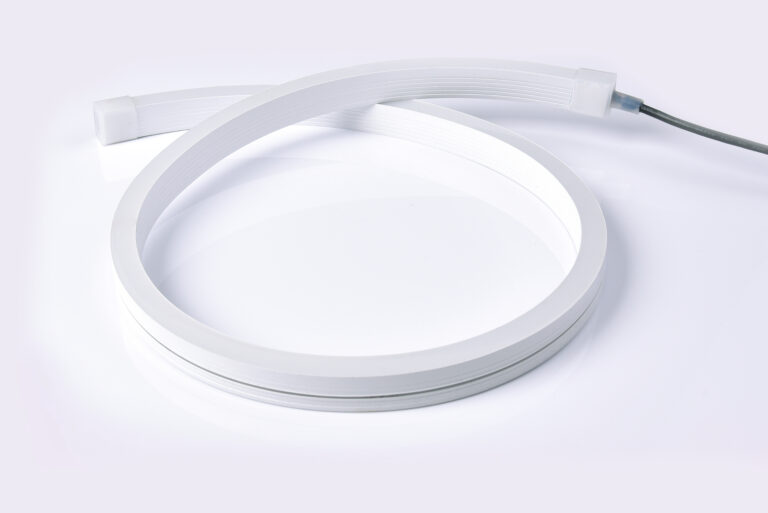
Choosing the right combination of diffuser, LED pitch, and driver will reduce returns and improve customer satisfaction. I’ve seen retailers cut post-sale complaints when they shifted to neon-flex with graded diffusers and paired constant-current drivers—measurable outcomes, not vague promises. If you want a reliable partner for samples and testing, consider working with a focused supplier who provides clear datasheets and sample returns policy. For an example of a supplier I work with and trust, see LEDIA Lighting. I’ll be blunt: sourcing without testing is a gamble, and I’ve learned that the hard way—so test, record, and then scale.